


A Discussion About Consciousness, Steiner, and the Mystery of Human Life
The Lemurians: A New Testament for the Soul

Laurence O’Bryan: Neil, I finished The Lemurians last night, and I’ll be honest—I closed the book and thought, I’m not sure if I just read a novel, a spiritual warning, or the beginning of a new religion.
Neil Perry Gordon: That’s probably the most dangerous compliment you could give me.
Laurence: Dangerous how?
Neil: Because I don’t want the book to feel like a religion. That’s actually one of the tensions inside the story. Nathan Adler, the main character, writes something called A New Testament for the Soul, and once people begin responding to it, he becomes deeply uncomfortable. He doesn’t want followers. He doesn’t want to be seen as a prophet. He’s a writer who has stumbled into something larger than himself.
Laurence: But you gave the book that subtitle, too. A New Testament for the Soul. That’s not exactly modest.
Neil: No, it isn’t. And I wrestled with that. But sometimes a title has to carry the weight of the question. The novel asks whether the soul needs a new language for the age we’re entering. Not a new church. Not a new doctrine. A new language.
Laurence: The book begins with Nathan watching footage of 3I/ATLAS, this strange interstellar object. What I liked is that he doesn’t immediately believe it means something. He keeps arguing with himself.
Neil: That was important. Nathan is not a man who says, “I have the answer.” He’s more like, “Something is bothering me, and I don’t know why.” That feels much more honest to me. Serious ideas often arrive that way—not as thunderbolts, but as pressure. You try to dismiss them, but they keep returning.
Laurence: And that pressure becomes the central question of the book: Did matter create consciousness? Or did consciousness enter matter so the soul could learn what it means to become human?
Neil: Yes. That’s the spine of the novel.
Laurence: Say that in ordinary language.
Neil: Are we only bodies that somehow became aware? Or are we souls using bodies to learn something?
Laurence: Much clearer.
Neil: Nathan takes longer to get there.
Laurence: He does. He really does.
Neil: Because he’s trying not to sound insane.
Laurence: Let’s talk about Lemuria. Many readers will hear that word and think of a lost continent, ancient ruins, or Atlantis-type mythology. But your Lemuria is different.
Neil: I’m not interested in Lemuria as a place someone might find with sonar equipment. In the novel, Lemuria is a previous condition of humanity. A lost way of perceiving. A time when human beings may not have experienced themselves as so separate from nature, from one another, or from the unseen world.
Laurence: That’s something I’ve thought about myself—the effect of technology, electricity, artificial light, and constant stimulation on the human mind. Try to imagine consciousness a thousand years ago, before electric light, before screens, before the scientific worldview shaped everything. And then go back even further, to a time before science existed at all. Human beings must have experienced reality differently.
Neil: Completely. That idea sits very close to the heart of the book. We often assume that consciousness has always been the same, and only our tools have changed. But what if consciousness itself has changed? What if the ancient mind did not simply know less, but perceived differently?
Laurence: Different levels of consciousness.
Neil: Yes. And perhaps different types of consciousness. The modern mind is powerful, analytical, scientific, individualistic. But something may have been lost along the way. Before artificial light, night was truly night. Before electricity, silence was deeper. Before technology filled every empty space, dreams, stars, seasons, animals, death, and memory may have spoken with a different authority.
Laurence: That’s beautifully put.
Neil: And that’s why Lemuria matters in the novel. It’s not nostalgia for the past. It’s the possibility that humanity once participated in reality more directly. Thought, nature, sound, and spirit were not as divided as they are now.
Laurence: Nathan connects this to the Austrian philosopher Rudolf Steiner.
Neil: He does. Steiner described Lemuria not simply as geography, but as an early phase of human consciousness. Whether one accepts that literally or symbolically, the idea is fascinating: that humanity’s inner life has evolved, and that our present consciousness is not the only possible form.
Laurence: But the book doesn’t let Nathan drift too far into mystical speculation. That’s where Leena Ruben comes in.
Neil: Exactly. Leena gives the story friction. Nathan moves by intuition. Leena asks, “What can we actually observe?” She’s a scientist, but not a cold skeptic. She’s open. She’s just cautious.
Laurence: She studies the eight-hertz signal connected to 3I/ATLAS.
Neil: Right. The signal gives the mystical question a physical anchor. Eight hertz is close to the alpha range of the human brain, which is associated with inward focus, meditation, relaxed awareness, and creativity. In the novel, the signal seems to interact with human attention.
Laurence: “Seems to” is doing a lot of work there.
Neil: It should. I don’t want the novel pretending everything has been proven. Uncertainty is part of the drama.
Laurence: Nathan says ATLAS may not be calling us, but tuning us.
Neil: That’s one of the central ideas. Most alien-contact stories imagine something coming from the outside to speak to us, save us, destroy us, or teach us. I wanted something stranger. What if the object activates something already buried within humanity?
Laurence: Like memory?
Neil: Yes, but not personal memory. More like soul memory. A field of memory. Something older than the modern self.
Laurence: That leads to the Soul-Line, one of the book’s biggest ideas.
Neil: The Soul-Line asks whether we inherit more than genetics. Bloodline tells us we come from our ancestors, and that’s true on one level. But the Soul-Line asks whether the soul carries another inheritance across lives.
Laurence: Reincarnation.
Neil: Yes.
Laurence: I’ll admit something here. I pray reincarnation is true. I don’t mean that casually. I mean, there is something profoundly comforting in the thought that life is not a single, brief appearance and then nothing.
Neil: I understand that completely. Reincarnation is comforting, but it is also demanding. If the soul returns, then life has consequences beyond one lifetime. We are not finished with one another as quickly as we think.
Laurence: That could be freeing.
Neil: Or terrifying.
Laurence: The novel shows both.
Neil: It had to. Some people in the story feel liberated by the Soul-Line. Others feel threatened. If identity does not begin and end with this one life, then everything is disturbed—religion, family, politics, grief, guilt, ambition, even love.
Laurence: Grief especially.
Neil: Yes. Grief forces the question. When someone you love dies, you either accept absence as final or you begin listening for another possibility. Not because you want fantasy, but because love itself refuses to feel temporary.
Laurence: That may be the most human answer you’ve given.
Neil: Good. The book has to stay human. Otherwise, metaphysical fiction can float away.
Laurence: Nathan nearly floats away at times.
Neil: He does. And Leena pulls him back. That’s why their relationship matters. She doesn’t simply admire him. She questions him. She recognizes something in him, but she refuses to let him become careless.
Laurence: There’s romance between them, but it’s restrained.
Neil: I wanted it to feel like recognition before desire. They are drawn to each other, but not in a glossy, convenient way. It’s awkward, careful, charged. They don’t fully understand what is happening between them.
Laurence: That makes it believable.
Neil: I hope so. When characters immediately know they are cosmically destined for each other, I usually stop believing them.
Laurence: Then the story escalates. Nathan’s writing goes viral. Religious leaders attack him. Young people begin calling themselves Lemurians. People report similar dreams. It starts to feel like a cultural event.
Neil: Because ideas don’t remain pure once they enter the world. Nathan writes from uncertainty, but the public wants certainty. Some people want to worship the idea. Others want to destroy it. That’s what happens when mystery becomes public.
Laurence: The Joe Rogan chapter surprised me.
Neil: It had to happen.
Laurence: Why?
Neil: Because in our world, if Nathan’s ideas exploded, they wouldn’t remain in quiet literary circles. They would hit podcasts, clips, arguments, reaction videos. Rogan represents that public threshold where fringe, science, spirituality, skepticism, comedy, and curiosity all collide.
Laurence: Nathan handles himself better than expected.
Neil: Better than he expects. But he’s not polished. He’s trying to be honest in real time, which is different from being prepared.
Laurence: Some readers may say, “This is beautiful, but it’s not science.”
Neil: And they’d be right.
Laurence: That’s refreshing.
Neil: The book is not science. It uses scientific language and speculative ideas, but it’s a novel. Its job is not to prove. Its job is to open a door.
Laurence: Open a door to what?
Neil: To the possibility that the human being is not finished. That consciousness is not a side effect. That the soul is not an outdated idea. That becoming human may be much more sacred, and much more difficult, than we have imagined.
Laurence: There’s a line in the book that will provoke people: “We are not fragments of a forgotten god. We are the god remembering itself through the many lives we live.”
Neil: It should provoke people. But in the novel, that is Nathan writing under the pressure of revelation. It’s not meant to be a neat theological statement. It’s meant to feel dangerous, beautiful, and possibly too much.
Laurence: What is the question you most want readers to feel?
Neil: Did matter create consciousness? Or did consciousness enter matter so the soul could learn what it means to become human?
Laurence: And what do you hope readers feel when they finish?
Neil: I hope they feel unsettled in a good way. I hope they wonder if their life is part of a longer story. I hope they look at other people with more tenderness. Because if the Soul-Line is real, then no one is only what they appear to be in this one life. Everyone is carrying hidden history. Hidden wounds. Hidden wisdom.
Laurence: That’s a generous way to see humanity.
Neil: I think we need a generous way to see humanity right now.
Laurence: Last question. Is The Lemurians a warning or an invitation?
Neil: Both. It warns us not to reduce the human being to biology, machinery, ideology, identity, or data. But it also invites us to remember that we may be more ancient, more connected, and more responsible than we think.
Laurence: Responsible for what?
Neil: For becoming fully human before we carry our unfinished soul into the future.
Laurence: That’s a strong place to end.
Neil: Then let’s pretend I planned it.
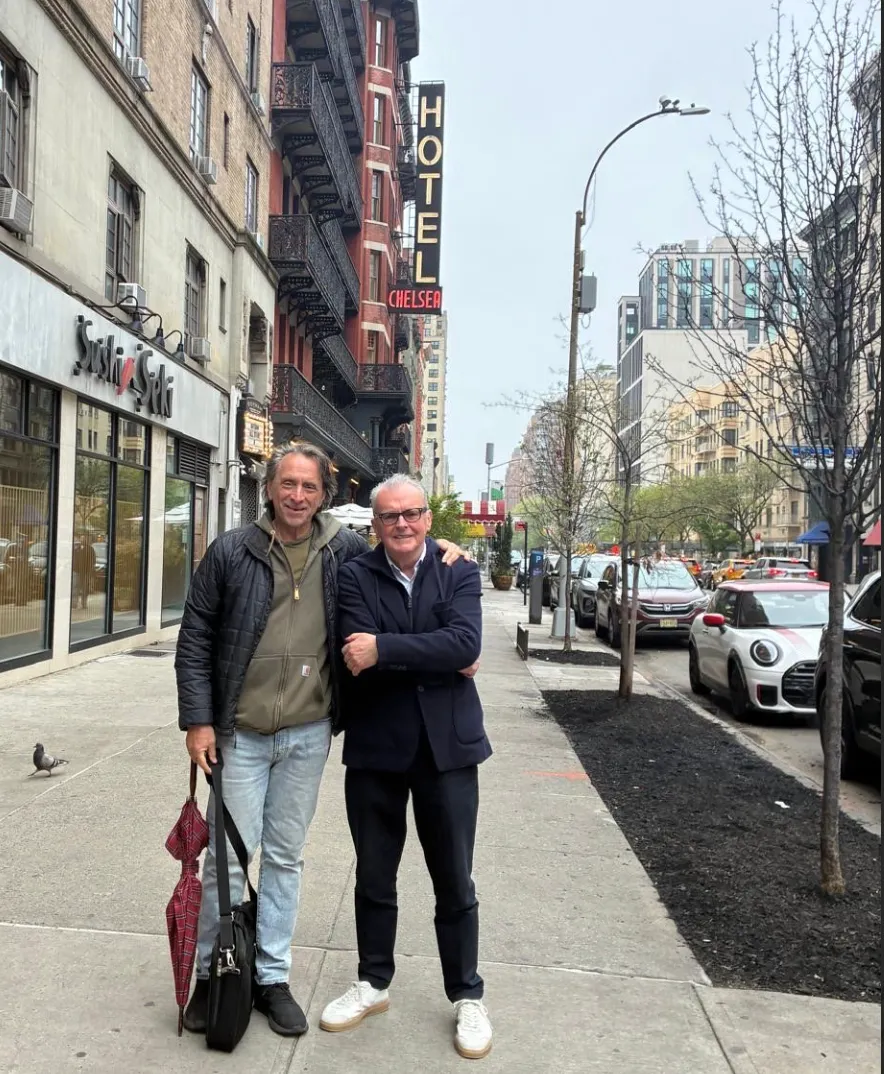
Who is Laurence O’Bryan?
Laurence O’Bryan is an internationally published novelist whose work has reached readers across the world. He had three novels published worldwide by HarperCollins, establishing him as a writer of commercial fiction with a broad global audience. His books have been translated into eleven languages and published by multiple international publishers, with editions appearing in markets ranging from Poland to Mexico.
One of his novels has also attracted interest beyond the page, having been optioned twice for screen adaptation — a sign of the cinematic quality of his storytelling and the wider appeal of his plots, characters, and historical imagination.
In addition to his internationally published thrillers, Laurence has written historical fiction, including A Dangerous Emperor, a series set during the turbulent final centuries of the Roman Empire. The series reflects his interest in political intrigue, collapsing civilizations, imperial ambition, and the human lives caught inside moments of historical upheaval.
He is currently developing another historical fiction series set in the immediate aftermath of the Battle of Hastings, focusing on the dramatic period after 1066 when the sons of King Harold escaped to Ireland. This setting allows him to explore exile, resistance, dynastic survival, and the violent reshaping of England after the Norman Conquest.
Beyond his novels, Laurence is also a prolific Substack writer and blogger. Through his essays and online writing, he continues to engage readers with reflections on fiction, history, publishing, creativity, and the writer’s life. His body of work reflects both a deep commitment to storytelling and a sustained curiosity about the turning points of history — moments when empires fall, kingdoms are remade, and ordinary people are forced to choose who they are.


Comments