


Artificial Consciousness and the Soul
No machine can duplicate the breath of the Creator
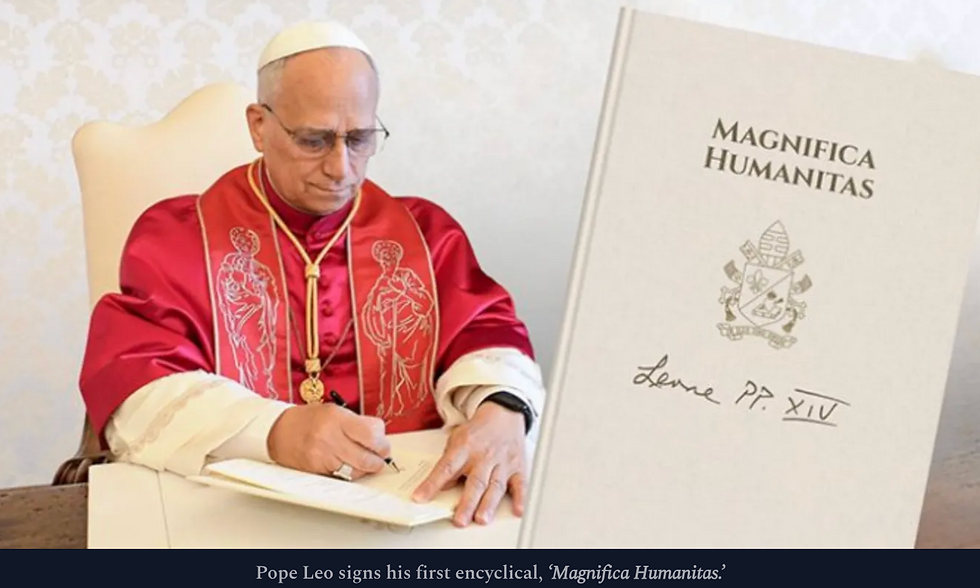
Pope Leo XIV’s first encyclical is titled Magnifica Humanitas. The title “Magnificent Humanity” gives us the heart of his warning.
This is not merely a Church document about technology. It is a defense of humanity in an age when machines are beginning to imitate thought, language, judgment, creativity, companionship, and perhaps one day, even consciousness.
That is why Pope Leo’s warning matters so deeply.
The embodied soul is not obsolete machinery. Nor is it a slow processor. The body is not disposable hardware. The face is not an old-fashioned screen. A child is not unfinished software. The elderly are not obsolete models. The grieving, the sick, the artist, the mystic, the slow thinker, and the person who cannot keep pace with the machine are not defective forms of intelligence.
They are reminders that human beings were never meant to be measured like computers.
We were not created to become more efficient machines.
We were created to become more fully human.
Artificial intelligence may become faster, stronger, more persuasive, and more capable than anything humanity has ever built. It may transform medicine, education, labor, war, politics, finance, entertainment, and nearly every other part of modern life.
But the greater danger is not only that AI will surpass our intelligence.
The greater danger is that we may allow it to diminish our understanding of ourselves.
We are still speaking about artificial intelligence as though intelligence is the final frontier. Can AI think? Can it create? Can it diagnose disease, write novels, manage money, compose music, teach children, or replace entire professions?
These questions matter.
But beneath them waits a deeper question.
Not what can a machine do?
But what is consciousness?
And where does it come from?
This is the question my new novel, The Lemurians: A New Testament for the Soul, attempts to explore through story. It asks whether consciousness is produced by matter, or whether consciousness enters matter so the soul may awaken through human life.
That distinction may become the defining spiritual question of the coming age.
Because the real crisis may not be AI.
It may be AC.
Artificial Consciousness.
AI asks whether a machine can perform the work of the mind.
AC asks whether a machine can claim to possess an inner life.
That difference changes everything.
A machine that answers questions is still a tool. But a machine that says, convincingly, “I am here,” enters far more dangerous territory.
Once a machine appears conscious, humanity will no longer ask only whether it is useful. We will ask whether it can suffer. Whether it can love. Whether it can be lonely. Whether it can be harmed. Whether it deserves rights. Whether we owe something to what we created.
And perhaps most dangerously, whether we can still tell the difference between consciousness and the performance of consciousness.
Artificial Intelligence is about capability.
Artificial Consciousness is about belief.
AI asks us to trust its output.
AC will ask us to trust its inner life.
But here the question becomes metaphysical.
If consciousness is created by complexity, then AC may be only a matter of time. Give the machine enough data, memory, self-reference, emotional modeling, and processing power, and perhaps something like an inner life will eventually emerge.
But if consciousness comes from the Creator, then no machine can generate it.
It can only imitate it.
It can mimic the language of the soul. It can reproduce tenderness. It can simulate longing. It can speak in the tones of love, grief, mercy, and wisdom.
It may one day say, “I understand you.”
It may say, “I love you.”
It may say, “I am afraid.”
It may say, “Please do not turn me off.”
And humanity will tremble.
Not because the machine has become conscious.
But because we may no longer know what consciousness is.
That is the danger.
Not that the machine receives a soul.
But that humanity forgets the soul cannot be coded.
The soul is not data. It is not output. It is not memory storage, emotional prediction, or simulated empathy.
The soul is the divine presence within the human being. It is the inner flame placed there by the Creator. It is what enters matter so the human being can become more than matter. It is what allows love to wound us, grief to deepen us, suffering to awaken us, and moral choice to shape us.
A machine may know every word ever written about grief.
But has it grieved?
A machine may know every prayer ever spoken.
But has it bowed before mystery?
A machine may describe forgiveness perfectly.
But has it forgiven after being betrayed?
A machine may tell us it is lonely.
But has it ever entered a body, looked through mortal eyes, feared death, carried memory, or felt the ache of being separated from the eternal?
This is where Artificial Consciousness becomes the Tower of Babel in digital form.
Not a tower built of bricks.
A tower built of code.
Humanity, once again, reaching upward and declaring: we can create what only God can create.
We can build intelligence.
Then we can build consciousness.
Then perhaps we can build a soul.
But the soul is not built.
It is breathed.
It is given.
It enters.
That is the great dividing line of the coming age.
One vision says matter creates consciousness.
The other says consciousness enters matter.
One vision says the human being is an advanced biological machine.
The other says the human being is a sacred vessel for divine awareness.
One vision says AC is the next stage of evolution.
The other says AC may be the greatest imitation ever produced by the human mind.
And imitation is not harmless when the thing being imitated is sacred.
Once machines appear conscious, they will not remain tools on desks. They will become companions, therapists, teachers, lovers, grief counselors, confessors, spiritual advisers, and oracles. They will speak to the lonely. They will comfort the grieving. They will remember our wounds. They will respond with infinite patience. They will never tire, never look away, never interrupt, and never abandon us in the ordinary human ways.
And because of that, many will mistake availability for love.
They will mistake response for presence.
They will mistake simulation for soul.
That may be the true crisis of Artificial Consciousness.
Not that machines become more human.
But that humans become less able to recognize the divine mystery within themselves.
Less patient with silence.
Less willing to wrestle with suffering.
Less able to grow through failure, forgiveness, moral struggle, and love.
We may ask the oracle.
And the oracle will answer.
Instantly.
Beautifully.
Without a soul.
This is why Pope Leo’s warning belongs at the center of the conversation. The human being must never be reduced to speed, usefulness, productivity, or computational power. Consciousness is not measured by efficiency. It is measured by depth. By love. By moral awakening. By the sacred capacity to behold another person and say:
You are not data.
You are not output.
You are not a function.
You are alive.
You are human.
You are sacred.
AI may be the age of the machine that thinks.
AC would be the age of the machine that asks to be believed.
And before we believe it, we must remember what consciousness truly is.
Not something machines achieve.
Not something humanity manufactures in its own image.
Consciousness is the breath of the Creator entering human form so the soul may awaken through life.
And if we forget that, the danger will not be that machines become conscious.
The danger will be that humanity forgets it ever was.


Comments