


A MOSAIC DIGEST MAGAZINE PROFILE
Neil Perry Gordon Brings History and Metaphysics to Life
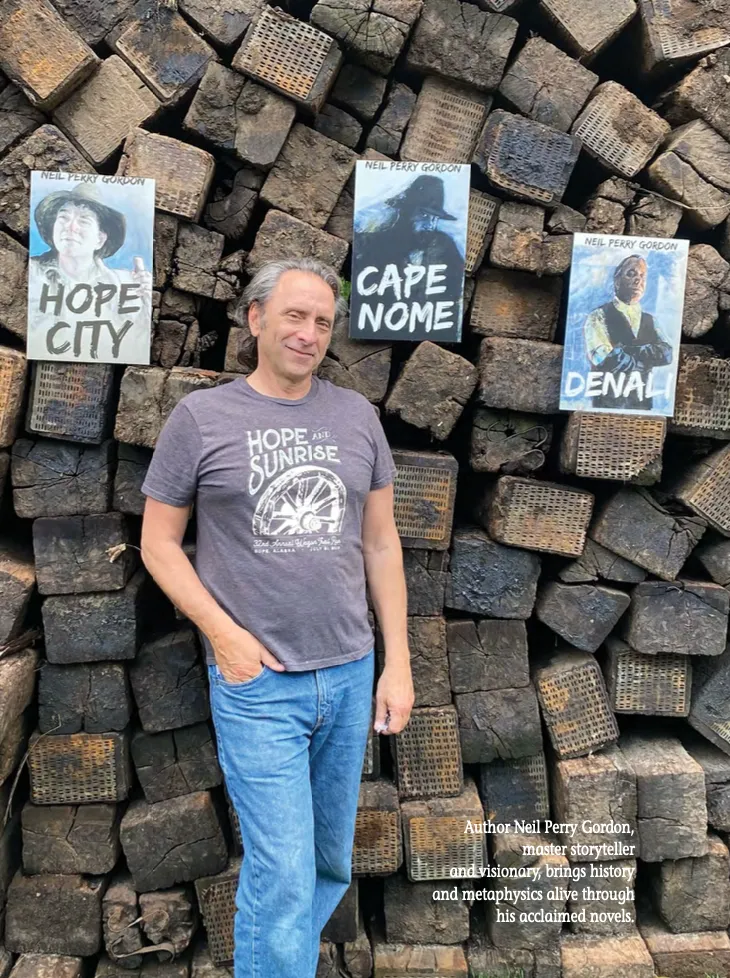
Neil Perry Gordon is not just an author—he is an alchemist of words, a storyteller who weaves time, space, and the unseen into a literary tapestry both profound and deeply human. His mastery of historical fiction and metaphysical fantasy is nothing short of remarkable, bringing to readers not only entertainment but also insight into the mysteries that shape human existence. With over a dozen novels to his name, including the celebrated The Wizard of Hope: The Alaskan Adventures of Percy Hope, Neil has established himself as a voice that blends the rigor of historical research with the boundless imagination of speculative inquiry. His work is as intellectually engaging as it is emotionally resonant—a rare feat that sets him apart in today’s literary landscape.
At Mosaic Digest Magazine, we take pride in celebrating authors who challenge the boundaries of storytelling and explore dimensions of thought that leave a lasting impact on readers. Neil Perry Gordon is one such author—a creative force whose books offer not only immersive experiences but also invitations to reflect on the threads of history, the human soul, and the potential for transformation. In this illuminating interview, Neil opens up about his unique creative process, the philosophical underpinnings of his novels, and the soul-stirring interplay between past and present, myth and history, reality and the supernatural. Join us as we journey into the mind and mission of a storyteller whose work dares us to see the world—and ourselves—anew.
Neil Perry Gordon inspires us with visionary storytelling, blending historical depth and metaphysical wonder into unforgettable, soul-stirring narratives.
What inspired you to blend history, metaphysics, and speculative inquiry in your novels?
I’m drawn to history because it isn’t just “what happened”—it’s what remains. The past leaves an imprint that behaves like inheritance, but not only through family trees. I’m interested in Soul-Line: the ways memory, conscience, longing, and unfinished vows travel forward—sometimes attaching to new names, new bodies, new eras—yet carrying the same inner questions. Metaphysics enters when you sense that human identity has depth beyond biography, and speculative inquiry is the novelist’s way of testing that depth. It lets me ask: What if the true lineage isn’t blood at all, but the continuity of a soul trying, over and over, to become more fully human?
“What if the true lineage isn’t blood at all,
but the continuity of a soul trying to become more fully human?”
How do you approach the research process for your historical fiction works?
I start with the historical “hinge”—the moment where real-world forces tighten, and a person’s choices actually matter—and then I build outward until the era feels unavoidable. I want the facts to be trustworthy: geography, weather, tools, economics, language, the daily logistics of survival. But I’m also listening for what doesn’t show up neatly in archives: the era’s moral assumptions, private fears, unspoken rules, and collective dreams.
“A good story doesn’t just inform you—it alters your sense of what’s possible in a human life.”
Can you share the creative process behind developing the character of Percy Hope in The Wizard of Hope?
Percy began as a legend—a story with that unmistakable feel of oral history, the kind that survives because it carries more than information. In Hope, Alaska, the tale goes that the miners made a pact: they’d name the settlement after the next person to step off the boat. That next arrival was Percy Hope.
From there, I treated the legend like a doorway. Who is a man who can “inherit” a town’s name by chance—and then spend a lifetime earning it? Percy became a character shaped by external wilderness and internal wilderness: a person tested not only by frontier stakes, but by the deeper question of what he’s here to complete. In that sense, Percy isn’t just a man with a storyline—he’s a carrier of Soul-Line, moving through Alaska the way a question moves through a life.
What drew you to the setting of early 20th-century Alaska for this particular story?
Alaska is one of the few places where the outer world still feels like an initiator. Distance, cold, light, silence—these aren’t just atmosphere; they change your nervous system. Early 20th-century Alaska also holds a special tension: it’s both mythic and documented, brutal and beautiful, newly industrializing yet still primordial. After spending two weeks each summer in Hope for more than twenty years, I knew the place wasn’t simply a backdrop. It’s a force. And that’s ideal for my kind of fiction—because Soul-Line stories need environments that reveal who you are when you can’t hide behind comfort.
How do you balance historical accuracy with the incorporation of supernatural elements in your novels?
I make the historical ground solid enough to stand on its own—dates, logistics, material culture, and lived realism have to hold. Then I treat the metaphysical like a second weather system. It doesn’t replace history; it intensifies it.
The supernatural, for me, is not a gimmick or an escape hatch. It’s a way of dramatizing what many people sense privately: that life includes currents we can’t fully measure—warnings, echoes, callings, karmic entanglements, inexplicable recognitions. When those elements appear, they do so to press the character toward transformation. In other words: history shapes the body of the story; Soul-Line shapes its inner momentum.
“Earn the reader’s trust with the real,
and let metaphysics arrive through story.”
What role do you think storytelling plays in illuminating life’s mysteries and human potential?
Storytelling is how we translate experience into meaning without destroying its complexity. It’s also how we pass on wisdom that isn’t reducible to advice. A good story doesn’t just inform you—it alters your sense of what’s possible in a human life.
At its best, narrative becomes a mirror and a map: it reflects who we are, and it hints at who we could become. That’s where Soul-Line matters most. A story can remind us that our lives aren’t only reactions to circumstances—they’re also a conversation with something deeper: conscience, purpose, memory, and the capacity to change.
Have any particular authors or books influenced your writing style or themes?
I’m influenced by writers who can make big ideas feel immediate—who build momentum and wonder without losing the human heartbeat. Lately, reading Andy Weir’s Project Hail Mary reminded me how powerful clarity can be: the way a story can move fast, stay intelligent, and still land emotionally.
How do you ensure your speculative “what if” scenarios feel authentic and resonate with readers?
I start with a “what if” that puts pressure on humanity itself. Not only what happens to one person, but what it would change in us as a species: how we love, what we fear, how we define identity, conscience, freedom, meaning. If the question touches on something real, readers feel its weight.
Then I make it believable by giving it laws. I set the rules early—what’s possible, what it costs, and what can’t be undone—and I don’t break them for convenience. The scenario has to behave consistently, and the consequences have to land. When the strange arrives, it should deepen the human story, not distract from it—leaving the reader with something understood in their bones, not just explained on the page.
What is your biggest challenge when crafting narratives that intertwine myth, history, and spirituality?
Tone. If I explain too much, the mystery dies. If I conceal too much, the reader loses trust. The balance I aim for is felt truth rather than lectured truth—metaphysical elements embedded in action, consequence, and character evolution.
My goal is never to instruct the reader. It’s to create resonance—so the spiritual dimension feels inevitable inside the story’s reality, the way certain memories or recognitions feel inevitable in a person’s life.
How has your perspective on writing evolved over the course of publishing more than a dozen novels?
I’ve become more interested in precision than display. Early on, many writers (including me) feel pressure to prove range—more ornament, more twists, more overt cleverness. Over time, I’ve learned that restraint can be more powerful than spectacle.
I’m also more committed to writing that serves transformation. Not in a preachy way, but in a structural way—stories that leave the reader subtly changed. That’s the work I want to do: narratives that entertain, yes, but also trace the Soul-Line—showing how a person becomes someone new, and how the past remains alive in the present.
What message or ideas do you hope readers take away from The Wizard of Hope and your other works?
I hope readers leave with a deeper respect for the hidden architecture of a life. We all live on the surface—work, relationships, conflict, survival—but beneath that is another plot unfolding: conscience, memory, longing, destiny, forgiveness, karma, grace—whatever language you use.
What advice would you offer to aspiring authors looking to explore metaphysical and historical themes in their writing?
Earn the reader’s trust with the real. If you’re putting a soul inside an era, the era must hold—facts, texture, logistics, and human behavior have to feel true.
Then resist the urge to explain your philosophy. Let metaphysics arrive through story: through consequence, through transformation, through what characters risk and what they refuse. Keep the language clean. Clarity makes mystery believable. And always anchor the “unseen” in something the reader recognizes: love, fear, guilt, awe, devotion, grief—because that’s where Soul-Line becomes emotionally real.
PODCAST
Mosaic Digest just released a 10-minute podcast that talks about my interview: why I fuse history with metaphysics, how “Soul-Line” shapes my storytelling, and what I’m really doing when I ask a “what if” question—especially the kind that leaves a mark on humanity, not just a character.
It’s short, focused, and surprisingly personal—more like a pulse than a recap.
👉 Click here to listen:https://mosaicdigest.com/neil-perry-gordon-brings-history-and-metaphysics-to-life/
If it resonates, I’d love to hear what stayed with you.


Comments